


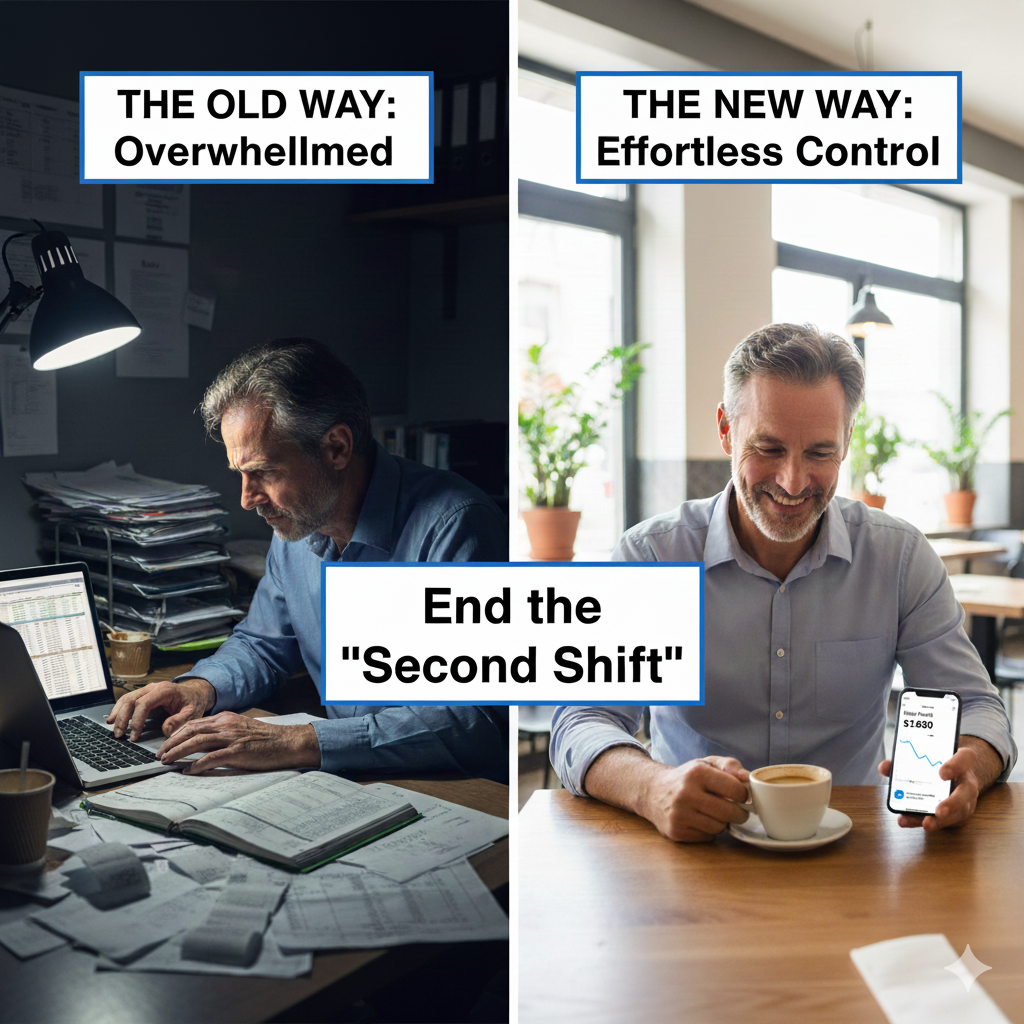
For independent restaurant owners, embracing restaurant financial automation is the key to trading the reality of financial administration for what truly drives the business: a passion for food. The “second shift“—hours spent after service reconciling sales, processing invoices, and wrestling with spreadsheets—is a major source of burnout and a critical blind spot for profitability. This guide provides a clear, step-by-step framework for automating these tasks, allowing you to reclaim your time and take precise control of your finances.
Why Manual Restaurant Finance is a Losing Battle
Before diving into solutions, it’s critical to understand why the ‘old way’ of managing restaurant finances is fundamentally broken, and why restaurant financial automation is the modern solution. It’s not a matter of working harder; the system itself is designed for failure.
- The Problem of Lag Time: Most owners only get a clear Profit & Loss (P&L) statement from their accountant weeks after the month has ended. Making critical decisions on 30-day-old data is like trying to navigate a busy kitchen blindfolded. You can’t fix a food cost issue from last month.
- The Problem of Inaccuracy: Manual data entry is the enemy of accuracy. A single typo when entering an invoice can cascade through your entire P&L, giving you a completely false sense of your margins and profitability.
- The Problem of No Visibility: Prime Cost (Total Cost of Goods Sold + Total Labor Cost) is the single most important metric for restaurant health. Yet, for most owners, calculating it accurately on a weekly or daily basis is nearly impossible, leaving them guessing about their financial standing at any given moment.
The 3 Pillars of Restaurant Financial Automation
To win this battle, you need a system. This framework is built on three pillars that work together to create a fully automated, intelligent back-office.
Pillar 1: Intelligent Invoice & Expense Management
The first step is to eliminate all manual data entry from paper receipts and supplier invoices. This is achieved with AI-powered Optical Character Recognition (OCR), which acts as an intelligent data extractor, not just a scanner.
An AI designed for restaurant workflows can read any PDF or even a crumpled photo of an invoice, understanding the difference between a supplier name, a line item, and a total, automatically extracting the data with over 99% accuracy.
The result is a real-time, digital-first accounts payable system. Food costs are tracked the moment an invoice is received, not weeks later. All expenses are categorized, and you gain a searchable digital archive, forever ending the “shoebox of receipts” and saving 5-10 hours of administrative work each week.
Pillar 2: Automated Sales Reconciliation & Daily P&L
The next pillar allows you to know, with confidence, if you made a profit every single day. This is built on direct API integration where an automation platform securely connects to your POS system (like Toast or Square), labor scheduling software, and business bank accounts.
Every 24 hours, it automatically pulls the necessary data, reconciles every transaction against your deposits, accounts for labor costs, and flags any discrepancies. Instead of a monthly P&L, you receive a “Daily Financial Snapshot” directly on your phone. This simple report shows yesterday’s sales against your key costs, giving you an estimated daily profit.
The “black box” problem is solved, you get a daily health check of your business. You can spot if food costs are creeping up or if labor was too high yesterday, and fix it today.
Pillar 3: On-Demand Financial Intelligence
The final pillar gives you the power to get answers to your most critical financial questions instantly, without ever opening a spreadsheet. This is where the magic happens. A conversational AI layer sits on top of all the data collected in Pillars 1 and 2, allowing you to query your own business’s financial data in plain language directly from a platform you already use, like WhatsApp.
This empowers you to make data-driven decisions on the fly. Before placing a big order, you can ask, “What was my actual food cost on the steak entree last week?” The AI can instantly calculate it and reply, “42%. The price from your main supplier went up 12% on the last invoice.”
You can ask about labor costs, sales trends, or budget variances and get an immediate, accurate answer. It’s like having a 24/7 financial analyst in your pocket.
From Blueprint to Reality
Individually, these systems are powerful. Together, they form a cohesive, automated back-office that gives you something you thought you’d lost: control.
While you could spend months trying to piece together different apps to build this, the real power comes from a single, unified AI that is custom-built for the unique chaos of a restaurant. That’s what we do at the Kousouf agency.
Ready to End Your “Second Shift”?
You’ve just read the blueprint for building a modern, automated back-office. The result is not just saved time; it’s the strategic advantage of clarity and control.
While the concepts are powerful, implementing them can be complex. That’s where we come in.
Our team specializes in building custom AI and automation systems tailored to the unique workflows of a restaurant. We handle the technical complexity so you can focus on running your business.
If you’re ready to see what a fully automated system would look like for you, the next step is a complimentary Automation Audit call. There’s no pressure and no obligation—just a clear, strategic conversation with an expert.