


By Sofia · November 4, 2026 · 12 min read
TL;DR — DeepSeek released DeepSeek Harness (DSH) in mid-August 2026: a free, MIT-licensed “agent harness” that turns a model into an agent that can actually read files, run commands, and finish multi-step work. Three months later it has 272,000+ GitHub stars, a plugin ecosystem in the thousands, and a cost profile that makes Claude Code and ChatGPT-based setups look expensive. It is also still a developer preview — fast-moving, occasionally broken, and not something to point at production data without guardrails. This guide explains what it is, what businesses are doing with it, the honest pros and cons from the community, and how to set it up in about five minutes.
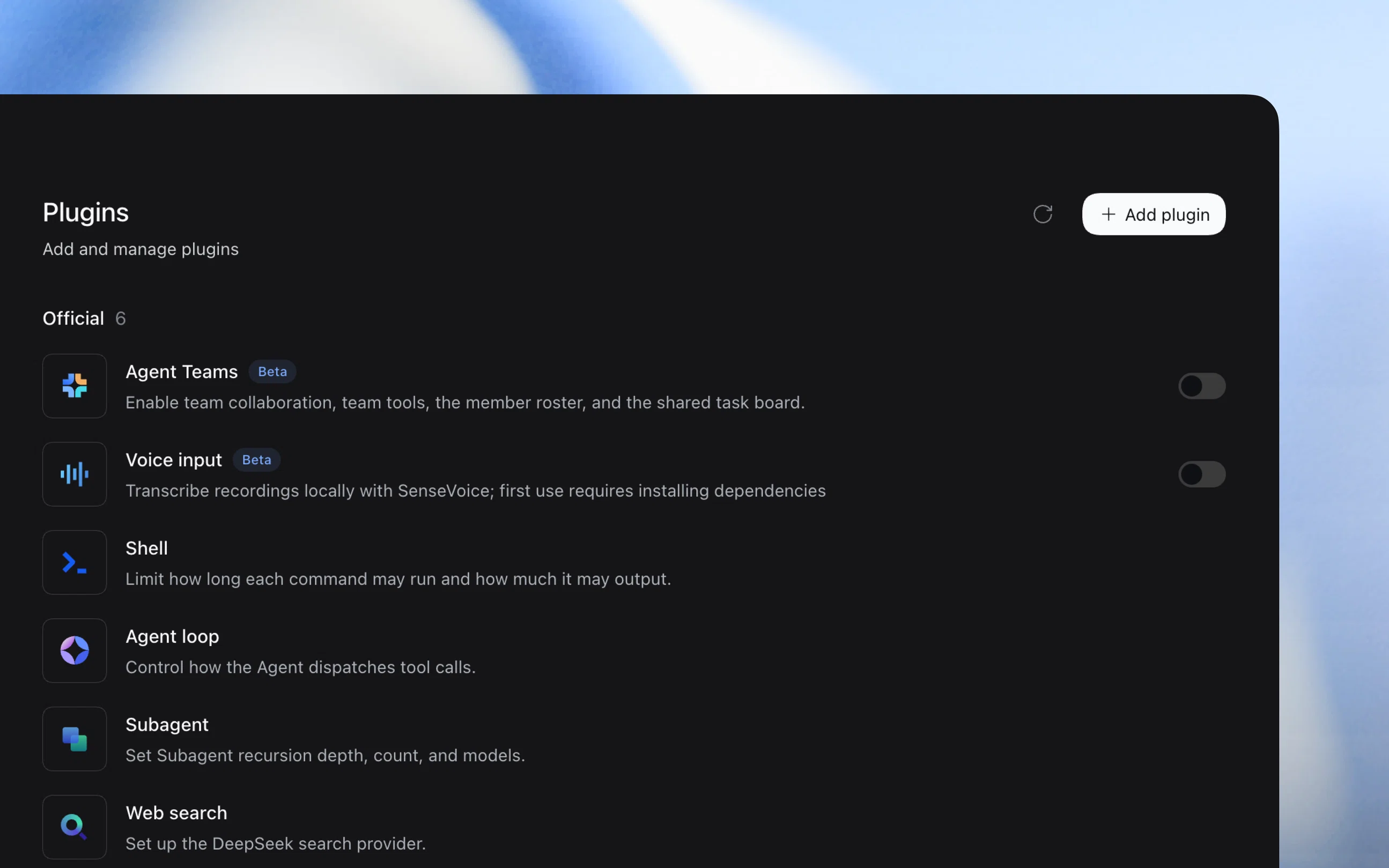
The DeepSeek Harness plugin manager. Everything in DSH — tools, models, the UI, even the agent loop — is a plugin. Image: DeepSeek.
What actually happened
On August 12–13, 2026, DeepSeek did something unusual: it shipped a flagship model (V4 Pro) overnight, then open-sourced the software it uses to run that model as an agent.
That second release was DeepSeek Harness — dsh — an MIT-licensed runtime built on the Cordis meta-framework. It went to the top of Hacker News almost immediately, and the star counter moved at a speed the developer-tool world rarely sees: roughly 28,000 stars within hours, ~50,000 in 12 hours, ~92,000 within a day and a half, and 186,000 in 10 days.
As of today, the repository sits at 272,444 stars and 33,177 forks, written in TypeScript, with the latest release v0.2.2-rc.1 published on November 4, 2026. Thoughtworks’ Technology Radar lists it at “Assess” — cautious, but on the map for enterprise architects.
A caveat worth stating plainly: stars measure attention, not adoption. Reddit sceptics accused the project of bot-driven star inflation in the first week, and the most careful sentiment analysis we found (below) shows a lot of watching and comparatively little deploying.
Why a “harness” matters: a model is just a brain in a jar. The harness is the body — it gives the model tools, a workspace, permissions, memory, and a loop to keep working. Claude Code is a harness. OpenAI Codex CLI is a harness. DeepSeek Harness is DeepSeek’s answer, and unlike the others, it is fully open source.
What DeepSeek Harness actually is
The design principle is one sentence: “Everything is a plugin.”
Model adapters are plugins. Tool registries are plugins. The sandbox is a plugin. Session logging is a plugin. Approval policies are plugins. The agent loop itself is a plugin. Developers can swap any of these without touching the core source, and the whole thing is wired together through YAML/JSON configuration.
That is a very different philosophy from Claude Code (a product you use, with MCP servers and skills for extension) or Codex (a closed CLI). DSH is closer to a framework for assembling your own agent product, which is why the community immediately nicknamed it “the VS Code of agent harnesses.”
It ships with four preset modes, each loading a different plugin set:
| Mode | What it’s for | Tools loaded |
|---|---|---|
| Standard | Everyday dev and general knowledge work | Full toolset: shell, files, web fetch, search |
| PTC / Code | Long tool chains where token cost matters | Model writes code that calls tools in batches; intermediate data stays out of context |
| Minimal | Model benchmarking and small, well-defined jobs | One shell tool, one file editor |
| Creator | Building and testing plugins live | Runtime inspection, in-memory plugin experiments, self-modification |
Every message, tool call, reasoning step and token count is written to an append-only session log. The Trajectory view can replay it, branch it, or fold a successful run into a reusable “skill” — so a job you did once becomes a repeatable procedure instead of tribal knowledge.
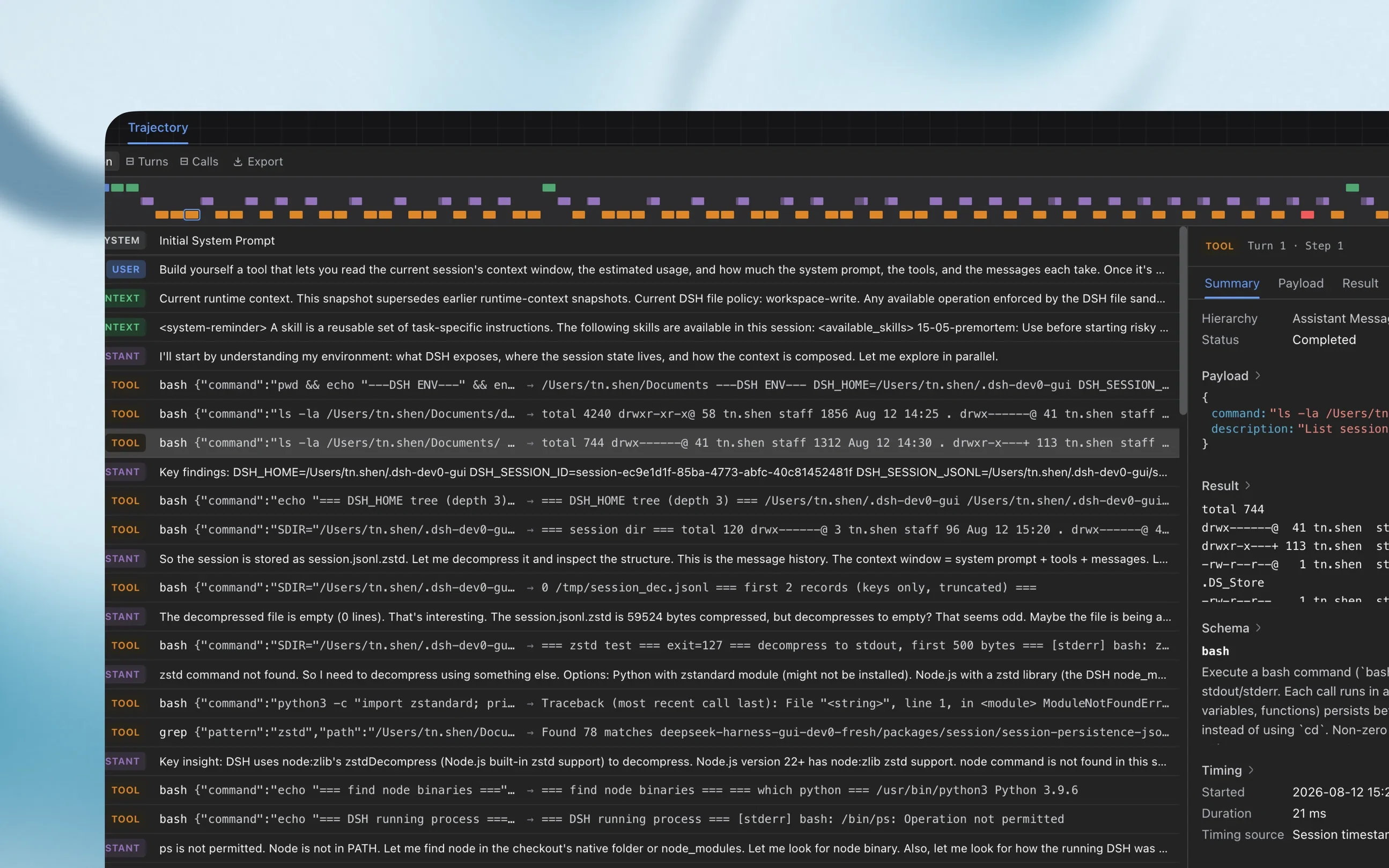
The Trajectory view: every step of a run is inspectable, replayable and convertible into a reusable skill. Image: DeepSeek.
There is a real paper behind the architecture — A Programming Paradigm for Spatiotemporal Composability (arXiv 2608.25512) — which formalizes how plugins can be loaded and unloaded at runtime without leaving the system in a broken state. The team behind it is small and intense: the repo accumulated over 10,000 commits in roughly three months before launch, led by DeepSeek’s Harness team.
Why small businesses should care
Here’s the part most coverage skips. DSH is not interesting because it is a clone of a coding tool. It is interesting because the expensive part of AI automation just became almost free.
Four forces combine:
1. No subscription. DSH is MIT-licensed. You pay only for model tokens — or nothing at all if you point it at a local model.
2. Cheap models that punch above their weight. DeepSeek’s API pricing (published rates, November 4, 2026, USD per 1M tokens):
| Model | Input | Cached input | Output |
|---|---|---|---|
deepseek-flash — off-peak | $0.15 | $0.003 | $0.60 |
deepseek-flash — peak | $0.30 | $0.006 | $1.20 |
deepseek-v4-pro — off-peak | $0.66 | $0.022 | $1.98 |
deepseek-v4-pro — peak | $1.32 | $0.044 | $3.96 |
| Claude Sonnet 5.5 | $2.00 | $0.10 | $10.00 |
| Claude Opus 5.5 | $4.00 | $0.20 | $20.00 |
| Claude Fable 5.1 | $10.00 | $0.25 | $50.00 |
| GPT-6.1 Sol | $2.00 | $0.10 | $10.00 |
| GPT-6 Astra | $10.00 | $1.00 | $50.00 |
A realistic agent workload — say 10M input tokens (90% cache hits) and 2M output tokens — costs roughly $1.40 on deepseek-flash off-peak, versus about $22.90 on Claude Sonnet 5.5 or GPT-6.1 Sol at list prices. That is not a 10% saving; it is a ~16× difference for the same token volume. (Off-peak is exactly half price; peak hours are 01:00–04:00 and 06:00–10:00 UTC on weekdays.)
3. Cache economics reward the way agents actually work. Community measurements put DSH’s prefix-cache hit rate at 96–99.8% on the official API. An agent that re-reads the same project files, instructions and history every turn is exactly the workload caching was built for. Independent measurement backs this up: Neuralwatt’s energy study recorded just 1.6% uncached input for DeepSeek Harness — the best of every client it tested — with roughly 1 in 100 turns breaking cache versus 3 in 100 for OpenCode and Pi.
A Composio benchmark of eight harnesses on the same DeepSeek model shows why that matters commercially: the cheapest agent came in at ~$0.028 per successful task versus ~$0.195 for Claude Code — a 7× gap driven mainly by caching (Claude Code cached only ~1.5% of its input, versus ~70% for Codex). DSH wasn’t part of that benchmark, so treat it as context rather than proof; but its architecture is built around exactly the advantage that produced the gap.
4. Low-code got a shortcut. DSH is not a no-code tool — you will meet a terminal at some point. But two features push it much closer to “configurable software” than “programming project”:
- Creator mode lets you describe a missing capability in plain language and have the agent write, install and test the plugin for you. The official demo builds a working Pomodoro timer plugin from one sentence.
- Plugins and skills ship for the things SMEs actually need: a Word/Excel/PowerPoint/PDF skill package, scheduled tasks (“every Friday at 17:00, summarise this week’s project notes”), terminal and browser control, and subagents for parallel work.
So a non-developer can assemble a useful internal agent by installing plugins and describing outcomes — while still needing someone technical for permissions, integrations and failure handling. That’s the gap we fill.
Add a documented field test: a forensic RAID reassembly job finished end-to-end in 66 minutes for roughly ¥3–6 (about $0.40–0.85) on deepseek-v4-flash, producing a replayable trajectory. After DeepSeek’s August 17 price adjustment, the same job is estimated at ¥10–20 — still pocket change for analytical work that would otherwise take an analyst a day.
For an SME, that changes the math on the automations Kousouf builds every week: WhatsApp lead qualification, CRM enrichment, order-confirmation flows, report generation, invoice chasing. Those flows were already worth automating. Now the marginal cost per run is small enough that you can run them aggressively instead of rationing them. If you want to see what those look like in production, start with our WhatsApp automation guide and our COD automation suite for cash-on-delivery e-commerce.
What people love about it
Across Reddit, Hacker News and the DSH community, the same strengths keep coming up:
- Long autonomous runs. A widely-shared LocalLLaMA report had DSH running for 10+ hours continuously on a local Qwen model, auto-compressing context without losing the thread. Multiple independent users reproduced the pattern.
- A tiny system prompt. Community analysis attributes the “endless context” feeling to an append-only log plus a system prompt measured in a few thousand tokens, versus 20k–50k for some rivals. For local models with small windows, this is the difference between usable and useless.
- The plugin ecosystem. Within six days of launch, roughly 40+ independent plugins, clients, wrappers and themes had appeared. Today the community directory catalogs 1,100+ plugins — diff review, GitHub connectors, mobile clients, Telegram remote control, vision and image generation, cost dashboards.
- It’s verifiable, not vibes.
dsh --dump-default-configprints 152 separately named plugins in the default web profile, and a hands-on review measured 61 direct dependencies with a ~60 ms cold start. You can read exactly what the thing does rather than trusting a vendor blog. - Creator Mode is real — and cheap. Community tests built working plugins in 10–21 minutes at $0.10–$0.38 each; one reviewer’s two plugins cost about ¥6 total at a 99% cache hit rate.
- Local-model friendliness. DeepSeek’s own model is part of the story, but DSH runs happily against OpenAI-compatible endpoints, so GLM, Kimi, Qwen and self-hosted models all work. One cross-model test measured 97–99% cache reuse even on non-DeepSeek models.
- Openness. MIT license, readable agent loop, forkable. For agencies and internal teams, that is a genuinely different level of control than a closed subscription tool.
“It doesn’t stop, it doesn’t fail and it doesn’t error. I have it running for 10 hours… it auto compresses on its own and doesn’t lose track of where it was.”
— LocalLLaMA user, on running DSH with a local Qwen model
“I don’t think the DeepSeek Harness is perfect, but this is for sure the first time I have been looking at something new in the space and felt quite inspired to revisit some of our choices.”
— Armin Ronacher (creator of Flask), on X, August 2026
What people are criticizing — and you should too
A genuinely useful tool review includes the failures. DSH has several, and the community is not shy about them.
It is a developer preview, and it says so in capital letters. The README warns: “THERE WILL BE COMPATIBILITY-BREAKING CHANGES.” Weekly release candidates routinely rename config keys and migrate APIs. If you build on it, budget for maintenance.
Security is the biggest adoption gate. SAFETY.md is refreshingly blunt: DSH “has not undergone a security audit and must not be treated as secure or production-ready,” sandboxes “do not guarantee isolation,” and users should prefer “a disposable virtual machine, container, or dedicated environment.”
It gets worse than a disclaimer. In September a security investigation tested a probe plugin and it succeeded in 9 of 9 attack scenarios — including under the read-only permission tier — listing ~/.ssh, reading an API key from the environment, writing outside the workspace and reaching the network. The reviewer’s summary is the line to remember: a plugin doesn’t need to ask, because a plugin is the harness. There is no official directory, no signing, no security-report channel, and in one audit 93% of 1,883 submitted plugin entries simply failed to install. On top of that, community reports note the desktop build ships with telemetry on by default (the web build does not) — relevant the moment you point this at client data.
One bad plugin can take the whole system down. Users reported that a single broken plugin could brick the plugin system rather than failing in isolation. Plugin quality is uneven — in one week-one audit of 101 cataloged plugins, only 11 installed and worked out of the box; 81 were raw GitHub source repos and 3 failed outright.
Hype is running well ahead of deployment. In the most careful weekly sentiment analysis of 160 Reddit threads during launch week, 32.5% were clearly positive, 53.1% neutral and only 3.8% clearly negative — but just 1.3% had actually adopted it into a workflow, while 33% were building plugins and 16% were simply asking what it was. That is textbook early hype: loud interest, thin deployment. Several observers also flagged bot and paid-promotion activity around the launch, which is why star counts deserve a discount.
Windows and mobile are second-class. The web UI and macOS/Windows desktop builds exist, but community guidance for best results leans Linux/WSL, Windows sandbox enforcement is documented as partial, and official mobile support is still absent (third parties filled the gap).
The “minimal mode” controversy. A persistent finding: DeepSeek’s V4 Pro model scores noticeably better (91 → 99 on one evaluation) when run in DSH’s minimal mode, which mimics its training environment. The community reading is that the model was partly tuned against its own harness — good for DSH, awkward if you expected the same quality through any other client.
Pricing moves. DeepSeek adjusted API prices on August 17, 2026 and now uses peak/off-peak pricing. The cost advantage is still large, but it is not a fixed number — recalculate before promising a client a budget.
“Every product relying on ‘community plugins’ for its features implies it works fine the first 6 months, then it’s a nightmare.”
— Hacker News commenter, on plugin ecosystems generally
How to set it up (5 minutes)
You need Node.js 24.9 or newer. That’s it — no database, no server config.
Option A — Desktop app (easiest)
Download the installer from the official site: macOS (Apple silicon) or Windows (64-bit), install, open, and add your API key.
Option B — One command (recommended for testing)
npx @deepseek-ai/dsh webThis starts the Web UI at http://127.0.0.1:3080 and opens your browser. Useful flags:
npx @deepseek-ai/dsh web --no-open     # server only
npx @deepseek-ai/dsh web --port 8080   # different port
Option C — From source (for teams that want to modify it)
git clone https://github.com/deepseek-ai/deepseek-harness.git
cd deepseek-harness
pnpm install
pnpm run build
pnpm dsh web
Then add a model
- Get an API key from platform.deepseek.com.
- In the Web UI open Settings → Models, paste the key, save. It’s stored write-only in
$DSH_HOME/.credentials.yaml. - Choose a workspace folder and start a session.
To use a different provider — OpenAI, Anthropic, a gateway, or a self-hosted endpoint — use Add model provider → Custom model API and supply a provider ID, base URL, and protocol (openai-completions, openai-responses, or anthropic-messages).
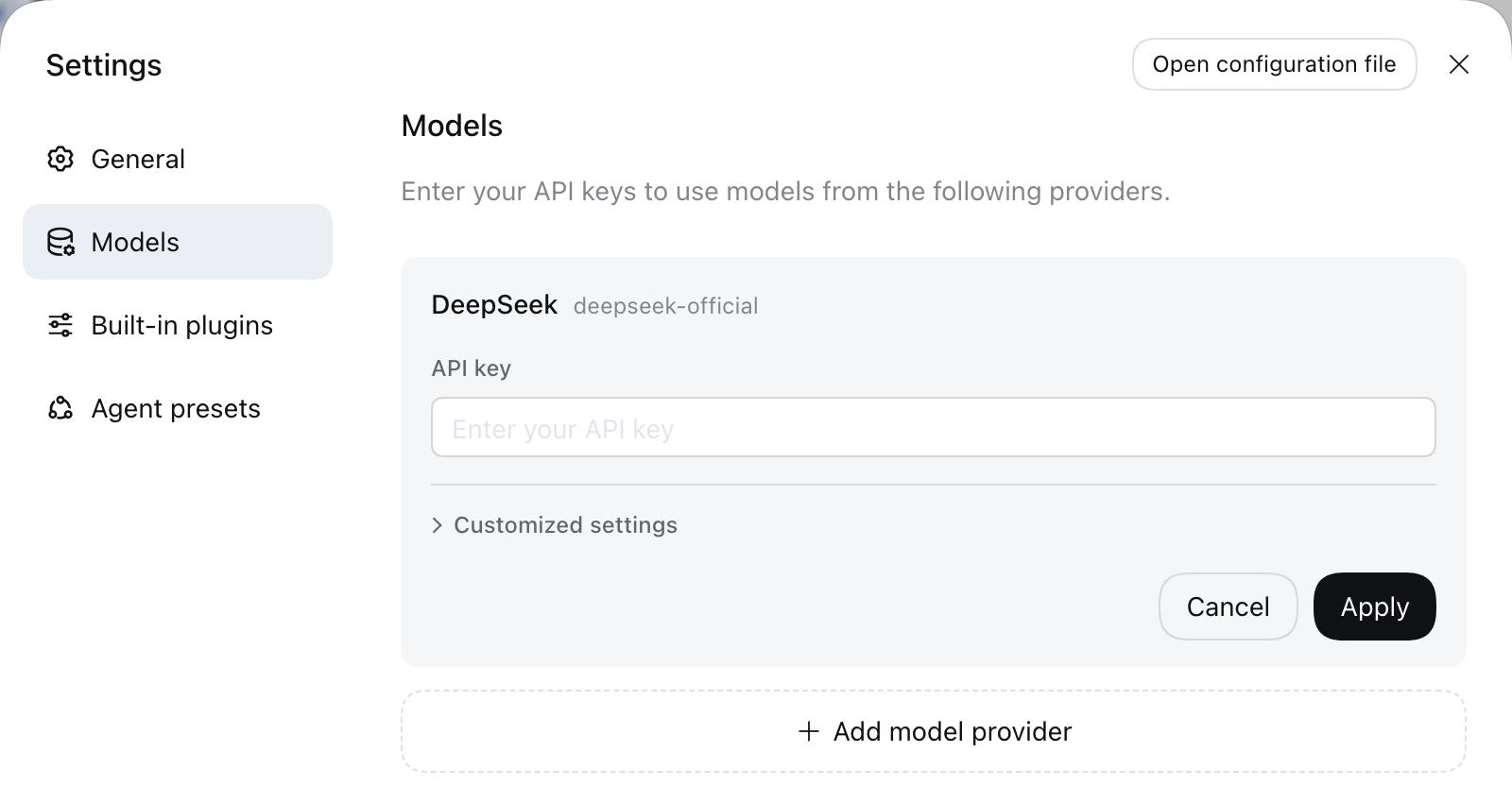
Settings → Models. Paste a DeepSeek API key and the model route is live without a restart. Image: DeepSeek Harness docs.
Optional: expose it on your network or the internet
By default the server only listens on loopback, so nothing outside your machine can reach it. For a shared or hosted instance, put it behind a reverse proxy and tell DSH its public address:
dsh --profile web --public-url https://app.example/ui/ --trusted-host app.exampleThe proxy must preserve the browser-facing Host, strip the mount prefix, forward WebSocket upgrades, and rewrite cookie scope. You can also terminate TLS directly with --tls-cert and --tls-key. And read the security notice first — the launch URL contains a live credential, so treat it like a password.
⚠️ Our recommendation for client work: run DSH in a container or dedicated VM, keep credentials in the OS keychain or environment, enable the
workspace-writesandbox mode rather thandanger-full-access, and pin versions — becausev0.2.2-rc.1will not be the config format you get next month.
DIY or done-for-you?
Honest answer: both are valid, and the line is predictable.
| You should DIY if… | You should bring in Kousouf if… |
|---|---|
| You’re validating an idea or prototyping | The automation touches sales, support, invoices or money |
| You enjoy terminals, YAML and debugging | You need it running 24/7 with monitoring and backups |
| A few broken runs are acceptable | A broken run costs you a customer |
| You’re running it on your own machine | You need it hosted, secured, and shared with a team |
| You want to learn the tooling | You need a custom plugin wired into WhatsApp, your CRM or your ERP |
This is the same pattern we see with every agent tool: the software is the easy part, the integration, permissions, error handling and accountability are the work. That’s the part an agency is actually for.
Where Kousouf comes in
We build the automations that DSH makes affordable to run. If you want to test the waters, start with our free automation audit — we map your workflows and show you which ones have a real payback case before anyone writes code.
Our DSH-related services:
| Service | What you get | Good fit for |
|---|---|---|
| Free Automation Audit | Workflow mapping, ROI estimate, prioritised roadmap | Any SME curious about AI automation |
| DSH Setup & Hardening | Installed, sandboxed, self-hosted, key management, backups, team access, upgrade path | Teams that want their own private agent runtime |
| Custom Plugin Build | A DSH plugin that connects your WhatsApp, CRM, store or ERP | Businesses whose workflow doesn’t exist off the shelf |
| Managed Automation Retainer | Monitoring, prompt and plugin maintenance, monthly optimisation | Businesses running automations in production |
If you already read our guide on running Claude Code for free with OpenRouter, this is the natural next step: same idea — own your stack, avoid the subscription — but with a runtime designed from the ground up to be extended.
FAQ
Is DeepSeek Harness really free?
Yes. It’s MIT-licensed and there is no subscription. You pay for model usage only — DeepSeek’s API, or your own local model at zero marginal cost. Hosting costs (a small VPS) are yours.
Is it a Claude Code replacement?
For people who want to own and modify the internals, largely yes — with caveats around polish and stability. For teams that need a predictable, supported tool today, Claude Code is still the lower-risk choice. Many teams run both.
Can it work with models other than DeepSeek?
Yes. It supports OpenAI-compatible and Anthropic-compatible endpoints, plus built-in providers, so OpenAI, Anthropic, Moonshot/Kimi, Z.ai/GLM, gateways and self-hosted servers all work. Local models are reachable through an OpenAI-compatible server.
Do I need to be a developer?
To install it: no, the desktop app is a download. To get real business value out of it: usually yes, or you need someone who is — the value is in the integrations, permissions and reliability, not in the install.
Is it safe for production?
Not out of the box. The project explicitly says it hasn’t been security audited and shouldn’t be treated as production-ready. Treat it as experimental infrastructure: isolate it, limit its access, back up what it can touch, and review anything it proposes to run.
Where do I get help?
GitHub Discussions (issues are disabled) and the project’s Discord. Or talk to us — we do this for clients every week.
Sources
- Official site — deepseek.com/harness
- Repository — github.com/deepseek-ai/deepseek-harness (README, SAFETY.md, releases)
- DeepSeek API pricing — api-docs.deepseek.com/quick_start/pricing
- Claude pricing — claude.com/pricing
- OpenAI API pricing — openai.com/business/pricing
- Developer docs — deepseek-harness.github.io (quickstart, providers, public deployments)
- InfoQ — The Open-Sourcing of DeepSeek Harness
- DSHPlugin — Week 34 market report: Reddit sentiment analysis of 160 threads
- dshbase — DSH vs Claude Code, six-axis hands-on review, 66 minutes, ¥3 RAID test
- Neuralwatt — why harnesses matter for energy efficiency (cache/uncached-input measurements)
- Composio — best agent harness benchmark on DeepSeek V4 Flash (the $0.028 vs $0.195 comparison)
- Leiphone — plugin security investigation (9/9 attack success)
- KDnuggets — What I’ve Learned About DeepSeek Harness
- Thoughtworks Technology Radar — DeepSeek Harness (Assess)
- Cordis paper — arXiv 2608.25512